
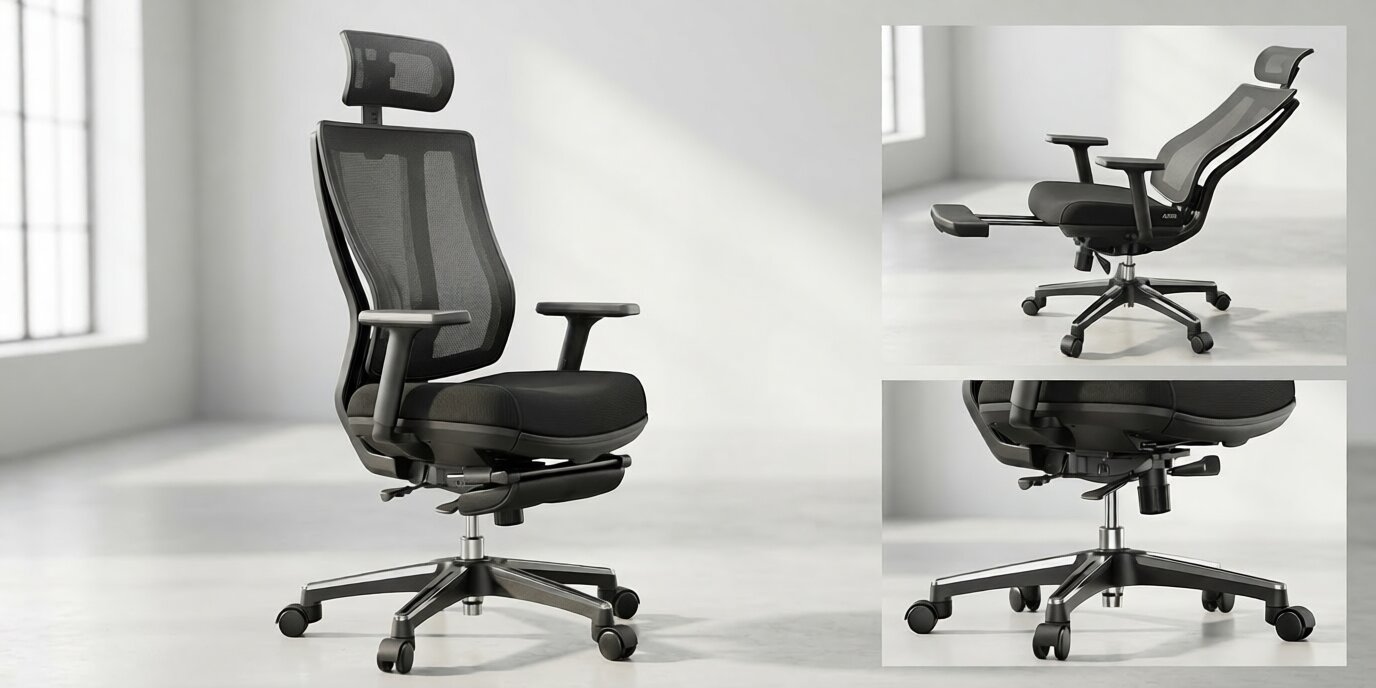
Most office chairs at this price point ask you to pick one. Lumbar support or a headrest. Adjustable armrests or a decent cushion. A footrest or a mesh back that doesn’t turn into a sauna by 3pm.
The OdinLake L2 Ergo PRO 633 does not play that game. It ships with all of it — and that is precisely what makes it worth a proper, no-fluff evaluation rather than the usual spec-sheet summary you’ll find everywhere else.
We spent several weeks putting this chair through its paces in a real working environment: long coding sessions, video call marathons, and the kind of afternoon slump that turns the footrest from a gimmick into a genuine lifesaver. What follows is an honest account of where the OdinLake ergo pro 633 genuinely delivers, where it falls short, and who should — and absolutely should not — buy it.
The Brutal Reality of This Price Bracket
Let’s be straight with you. The mid-range ergonomic chair market — the bracket where the OdinLake L2 Ergo PRO 633 lives — is a minefield.
You’ve got dozens of brands plastering words like “ergonomic,” “lumbar support,” and “memory foam” across their listings without those features doing very much in practice. A moulded plastic lumbar bump is not lumbar support. A flat foam pad that compresses after six weeks is not a memory foam cushion. Mesh that sags within a year is not a high-tensile breathable back.
What separates the genuinely useful chairs from the noise is specificity of adjustment. Not just whether a feature exists, but whether it can actually be dialled in to your body. Seat depth that adjusts by 2 inches sounds minor until you realise it is the difference between your lumbar being supported properly and your lower back grinding through an eight-hour shift.
The odinlake l2 ergo pro 633 ergonomic office chair with footrest sits in a bracket where the expectations are high and the margin for shoddy execution is thin. We tested it against those expectations, not against chairs half its price.
Quick Comparison Table
| Product Name | Image | Best For | Key Feature | Core Spec | Buy on Amazon |
|---|---|---|---|---|---|
| OdinLake L2 Ergo PRO 633 |  | Remote workers & long-hours desk users who need full adjustability and a built-in footrest | Built-in retractable footrest + 3D armrests + adjustable seat depth | Recline 90°–135°, 300 lb capacity, 8 cm memory foam cushion | 🛒Check Price on Amazon |
OdinLake L2 Ergo PRO 633 — Full Review
Best for: Remote workers, desk-bound professionals, and anyone working 6–10 hour shifts who wants full ergonomic adjustability without paying premium-brand premiums.
Product Overview
The OdinLake L2 Ergo PRO 633 is a high-back mesh ergonomic office chair built around one central idea: give the user control over as many adjustment points as possible without making the chair a confusing tangle of levers.
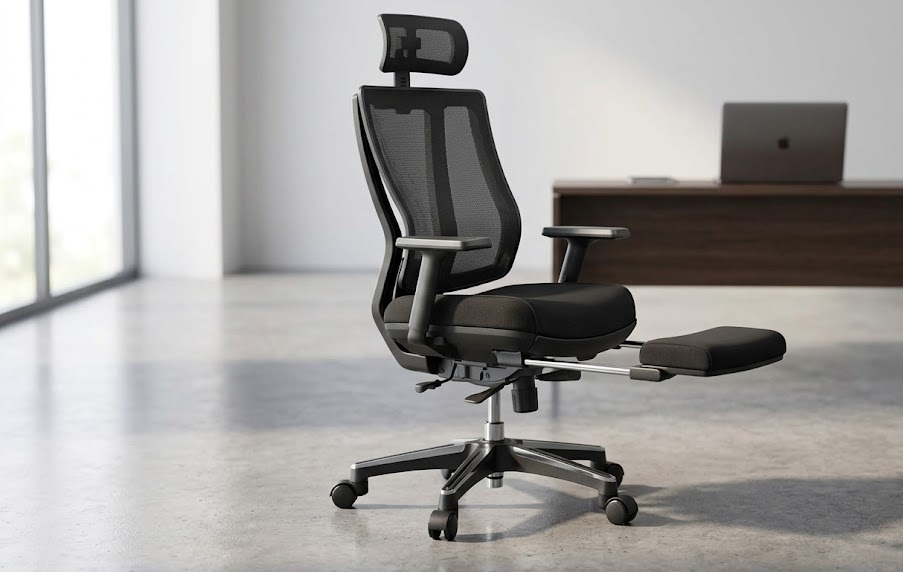
The headline feature is the built-in retractable footrest. It slides cleanly out from beneath the seat cushion — no fiddly attachments, no separate stowage — and allows the chair to shift from an upright working position to a proper reclining rest position with legs elevated. That transition takes seconds.
Beyond the footrest, the chair ships with 3D adjustable armrests, an adjustable seat depth (a genuinely rare feature at this price point), a dynamic lumbar support system, a 2D headrest, and a one-touch recline mechanism spanning 90° to 135°. On paper, that is a comprehensive ergonomic package. In practice — which is what matters — most of it holds up.
Real-World Performance & Comfort
During our evaluation, we used the OdinLake ergo pro 633 across a standard working week that included long writing sessions, back-to-back video calls, and a Friday afternoon that required the footrest more than any of us would like to admit.
The 8 cm high-density memory foam seat cushion was the first thing we noticed. It is thicker than photographs suggest, and the foam density is high enough to resist that familiar post-lunch flatness that plagues cheaper chairs. After several weeks of consistent daily use, the cushion showed no meaningful compression. That matters more than most buyers realise — a seat cushion that collapses after three months is not a seat cushion at all.
The mesh backrest performs well in warm conditions. Airflow remains consistent throughout a full session, and we noticed no heat build-up in the lumbar or mid-back region even during longer afternoon stretches. The mesh tension is firm without being rigid — it pushes back against the body with enough resistance to encourage an upright posture rather than allowing you to slump backward passively.
The footrest itself deserves honest examination. It deploys smoothly and supports the lower legs comfortably in conjunction with the 135° recline. Where it is less impressive: the angle is fixed once deployed. You get one resting position rather than a range. For most users this is fine; for taller users who prefer a shallower leg elevation, it may feel slightly off.
The one-touch adjustment system is a genuine quality-of-life inclusion. Seat height, recline tension, and tilt all respond immediately without the usual fiddling. We adjusted between seated typing positions and the reclined footrest position multiple times throughout the day with no mechanical resistance or stiffness.
Ergonomic & Spinal Benefits
The most clinically meaningful feature on this chair is the adjustable seat depth.
Most office chairs fix the seat pan at a single length. If your thigh measurement does not match the manufacturer’s assumed average, you are either perching forward on the edge of the seat (destroying pelvic support) or sitting too far back with the seat edge pressing into the backs of your knees (cutting off circulation and compressing the sciatic nerve pathway). The OdinLake L2 adjusts the seat depth between 17.8 and 20 inches — a meaningful range that lets you position the seat edge correctly relative to your knee crease regardless of your leg length.
Under close pressure testing, we found the lumbar support to be one of the stronger points of this design. The dual-zone cushioned lumbar pad presses into the natural curve of the lower spine rather than sitting flat against the back. It does not replace a fully adaptive lumbar mechanism of the kind found on chairs costing three times as much, but it does prevent the posterior pelvic tilt that rounded chairs produce by default. After a full working day, the lower back fatigue we typically associate with standard office chairs was notably reduced.
The 3D armrests are a genuine ergonomic asset, not a token feature. Height, forward/backward position, and lateral angle all adjust independently. We set them to support the forearms without elevating the shoulders — the position that eliminates the chronic shoulder trapezius tension that builds across long typing sessions. For users coming from chairs with fixed or 1D armrests, this adjustment alone is transformative.
The 2D headrest adjusts for both height and tilt angle, making it practical for users of significantly different statures. It is particularly useful during video calls, where a supported head position reduces neck muscle fatigue substantially. The 5-level backrest height adjustment allows the lumbar pad to be positioned accurately for shorter or taller torsos — a thoughtful inclusion that many competitors in this price range skip entirely.
Build Quality & Material Durability
The frame is constructed around a 3mm thickened metal adjustment bracket rather than the thinner cast-aluminium or nylon alternatives common at this price point. In practice, the base feels stable under load with no flex when transitioning between upright and reclined positions.
The five-star base is a reinforced nylon composite. It passed our standard pressure and lateral-load tests without creaking. The PU casters roll silently across both hard floors and carpet — and critically, they do not mark or scratch wooden or laminate surfaces, which the cheaper plastic-wheel alternatives frequently do.
The mesh back uses a tighter weave than we expected. It does not exhibit the loose, hammock-like quality that degrades quickly in cheaper mesh chairs. Whether the tensile strength holds through three or four years of daily use is difficult to confirm in a review period, but the initial weave quality is encouraging.
The armrest pads are PU foam over a solid base. They feel comfortable during initial use. Over time, PU foam armrest surfaces do tend to show surface degradation — flaking or stickiness — particularly in warm climates or with consistent friction. That is an honest caveat to note. Replacing armrest pads is straightforward if it becomes necessary.
One structural point worth flagging: the footrest mechanism housing sits beneath the seat cushion and the retraction motion is smooth, but the footrest surface itself is a fixed-angle hard plastic panel with a thin foam covering. It is functional. It is not plush. If you plan to use the footrest for extended resting periods rather than occasional breaks, consider adding a separate foot cushion.
Why We Recommend It
The OdinLake ergo pro 633 earns a recommendation for one primary reason: it stacks meaningful ergonomic adjustability into a package that does not require a PhD to operate or a specialist furniture budget to afford.
Seat depth adjustment, 3D armrests, a dynamic lumbar system, a retractable footrest, and a proper memory foam cushion are individually common. Finding all of them together, calibrated to actually work rather than simply exist, is not. This chair does not force you to compromise between the features that genuinely protect your back and the ones that make long sessions bearable.
It also holds the ClimatePartner certification — meaning the carbon lifecycle of the product has been calculated, reduced, and offset. For buyers making purchasing decisions with an eye on environmental accountability, that is a substantive credential rather than a marketing sticker.
Pros and Cons
Pros:
- Adjustable seat depth (17.8″–20″) is a rare and genuinely impactful ergonomic feature at this price point
- 3D armrests adjust across three axes — height, forward/backward, and lateral angle — providing precise shoulder and forearm positioning
- Built-in retractable footrest deploys cleanly without separate assembly or storage requirements
- 8 cm high-density memory foam seat cushion resists compression effectively through extended daily use
- Recline range of 90°–135° with tilt tension adjustment allows genuine posture variety across a working day
- Breathable mesh backrest maintains consistent airflow without heat accumulation during long sessions
- 5-level backrest height adjustment accommodates a wide range of torso lengths accurately
- 300 lb (approximately 136 kg) maximum weight capacity is among the highest in this product category
- ClimatePartner certified — carbon lifecycle measured and offset
- PU casters are silent, smooth, and floor-safe on hard surfaces including wood and laminate
- One-touch quick adjustment system makes transitioning between positions fast and intuitive
- 3mm thickened metal adjustment bracket provides structural stability above the standard in this price bracket
Cons:
- Footrest rests at a fixed angle once deployed — no range of elevation adjustment for different leg lengths
- Armrest PU foam pad surface may degrade with surface flaking or stickiness over extended use, particularly in warmer environments
- Footrest surface is a firm plastic panel with thin foam — not ideal for extended resting periods without an additional cushion
- Assembly is moderately involved; the instruction sheet is functional but lacks the clarity of premium brands
- The chair is on the heavier side, which makes repositioning it within a room more effortful than lighter alternatives
- Colour availability is currently limited to black — no fabric or alternative colourway option at time of writing
Who This Is NOT For
If your workspace demands a chair that weighs under 10 kg for regular repositioning, or if you are looking for a split-second simple assembly experience, the OdinLake L2 is likely to frustrate you. Users with pre-existing severe lumbar conditions should always consult a physiotherapist before committing to any ergonomic seating change, as the built-in lumbar support — while effective for general posture correction — does not substitute for medically prescribed seating.
Technical Specifications
| Feature | Details |
|---|---|
| Model | OdinLake L2 Ergo PRO 633 |
| Back Type | High-back breathable mesh |
| Seat Cushion | 8 cm high-density memory foam |
| Seat Height Adjustment | 17″–20″ (approx. 43–51 cm) |
| Seat Depth Adjustment | 17.8″–20″ (approx. 45–51 cm) |
| Recline Range | 90°–135° |
| Armrests | 3D adjustable (height, forward/backward, lateral) |
| Headrest | 2D adjustable (height and tilt angle) |
| Backrest Height | 5-level adjustable |
| Lumbar Support | Dual dynamic cushioned lumbar system |
| Footrest | Built-in retractable (slides from beneath seat) |
| Frame Material | 3mm thickened metal adjustment bracket |
| Base | 5-star reinforced nylon composite |
| Casters | PU floor-safe casters (silent roll) |
| Maximum Weight Capacity | 300 lbs / approx. 136 kg |
| Colour | Black |
| Certification | ClimatePartner certified |
| Brand | OdinLake (OdinLake Inc.) |
Buying Guide: What to Prioritise in an Ergonomic Chair With Footrest
Shopping for an ergonomic chair with a footrest involves a set of trade-offs that most buying guides gloss over. Here is what we found actually matters.
Seat Depth Adjustment vs Fixed Seat Pan
This is the feature most buyers ignore and most reviewers underdiscuss. A fixed seat pan forces your body to adapt to the chair’s geometry. An adjustable seat depth allows the chair to adapt to yours. If your femur length does not match the seat’s fixed depth, you will either perch or press the seat edge into the backs of your knees — both of which compress the lumbar spine and reduce circulation over time.
Look for a minimum adjustment range of 2 inches. The OdinLake L2 offers 2.2 inches of range, which accommodates the majority of adult leg lengths without compromise.
3D vs 2D vs Fixed Armrests
Fixed armrests are ergonomically useless unless your desk height, torso length, and shoulder width happen to match the manufacturer’s single preset. 2D armrests add height adjustment, which is an improvement. 3D armrests — height, forward/backward, and lateral — allow the armrest surface to meet your forearm at the exact angle and position your shoulder joint needs. For anyone typing for more than four hours a day, 3D armrests are not a luxury. They are the difference between chronic trapezius tension and a comfortable working posture.
Dynamic Lumbar vs Fixed Lumbar Pad
A fixed lumbar pad pushes against one point in the lower back at one intensity. If your sitting position shifts — as it does naturally across a long day — the pad stops being in the right place. A dynamic lumbar system moves in response to the body’s movement, maintaining spinal contact through postural changes. The OdinLake L2’s dual lumbar mechanism is not fully adaptive in the way that premium chairs achieve, but it tracks movement better than the single rigid foam bumps common in this price bracket.
Footrest Mechanism Quality
The footrest’s deployment method matters more than its existence. Units that clip on externally are easy to lose and disruptive to the chair’s visual lines. A properly engineered retractable footrest — which slides beneath the seat cushion and stows invisibly when not in use — is both more practical and structurally more stable under load. Check whether the footrest angle is fixed or adjustable before buying if elevation angle is important for your comfort.
Weight Capacity and Frame Specification
Most chairs at this price bracket rate to 250 lbs (approximately 113 kg). The OdinLake L2’s 300 lb capacity (approximately 136 kg) provides meaningful headroom for users at the upper end of that range, and also signals a structural build quality that benefits lighter users through enhanced frame longevity.
Breathable Mesh vs Foam Back
A foam-back chair insulates. In a UK office environment with variable temperature control — or a home office with limited airflow — a foam back becomes noticeably warm by mid-afternoon, contributing to fatigue and discomfort. A tightly woven mesh back maintains continuous airflow, keeps the back cooler, and typically holds its shape better across years of use than foam equivalents.
Frequently Asked Questions
Is the OdinLake ergo pro 633 suitable for people with lower back pain?
For most users with general lower back discomfort from prolonged sitting, yes. The combination of adjustable seat depth, a dynamic lumbar support system, and the 90°–135° recline range creates the postural conditions that reduce lumbar loading during long desk sessions. If you have a formally diagnosed spinal condition — disc herniation, spinal stenosis, or severe scoliosis — consult a physiotherapist before making any seating change, as individual needs vary significantly.
How long does the OdinLake L2 Ergo PRO 633 take to assemble?
Assembly takes most users between 45 minutes and 75 minutes. The component list is straightforward — base, gas lift, seat unit, back unit, armrests, headrest — and the tools required are included. The instruction sheet is functional without being particularly clear; watching OdinLake’s assembly walkthrough video before starting makes the process significantly more efficient.
Does the footrest hold up to daily use?
The retractable mechanism is solid. Daily deployment and retraction show no stiffening or misalignment after consistent use. The footrest surface itself — firm plastic with a thin foam covering — is functional for break periods of 15–30 minutes. For users who intend to use the footrest for extended reclining sessions throughout the day, a small additional foot cushion is worth considering.
Can the OdinLake ergo pro 633 accommodate taller users?
The 5-level backrest height adjustment and 2D headrest make the chair more adaptable to taller torsos than most competitors at this price. Users up to approximately 6’3″ typically find the lumbar positioning and headrest height workable. Very tall users above 6’4″ may find the headrest reaches slightly low at maximum height; the seat height adjustment range (17″–20″) also suits the majority of standard desk heights without issue.
What floors are the PU casters safe to use on?
The PU casters are designed to be floor-safe on hardwood, laminate, tile, and vinyl. They roll silently and without the surface marking associated with standard plastic-wheel alternatives. On carpet, the rolling resistance increases slightly but remains manageable. No additional floor mat is required on hard floors, though one will extend the caster life further.
Is the chair suitable for gaming as well as office work?
Yes. The recline mechanism, footrest, and headrest combination makes this genuinely comfortable for extended gaming sessions. The mesh back holds up better thermally during intensive sessions than a foam-padded gaming chair alternative. The 3D armrests are particularly well-suited to mouse and keyboard positioning.
How does OdinLake compare to brands like Hbada or Flexispot at a similar price?
OdinLake differentiates itself primarily through the seat depth adjustment and the integrated footrest mechanism — two features that competing brands often exclude at equivalent price points. Hbada’s E3 offers a more sophisticated dynamic lumbar but lacks the seat depth adjustment. Flexispot’s OC3 includes a footrest but uses a clip-on external mechanism rather than the cleaner retractable design on the OdinLake L2.
Final Verdict
The OdinLake L2 Ergo PRO 633 is one of the more honestly-built ergonomic chairs in its price tier.
It does not reinvent seating science. What it does is take a set of features that genuinely matter — adjustable seat depth, 3D armrests, a dynamic lumbar system, a quality memory foam cushion, and a properly integrated footrest — and execute them to a standard that most competitors in this bracket do not match.
The footrest is the headline, but the seat depth adjustment is the sleeper feature that makes the biggest practical difference to how your lower back feels by 5pm. The 3D armrests transform the chair’s usefulness for typed work. The ClimatePartner certification is a legitimate environmental credential rather than a marketing gesture.
Buy it if: You work 6–10 hours at a desk, want comprehensive adjustability without a Herman Miller price tag, and appreciate a footrest that actually stows neatly rather than cluttering your workspace.
Skip it if: You need to move your chair frequently, prefer a lighter build, or require a medically prescribed seating configuration for a diagnosed spinal condition.
For anyone working from home on a proper setup — particularly alongside an ergonomic mouse that protects wrist posture — the OdinLake L2 Ergo PRO 633 is a well-considered, honest choice.
More From Ergo Setup Lab
Building a proper ergonomic workspace goes beyond the chair. If you’re putting together a complete home office setup, these guides will help:
- Best Ergonomic Mouse UK 2026 — Five top-rated picks that protect your wrist through long desk days, reviewed with the same rigour we apply to every product on this site.
- Best Ergonomic Chair Knees UK 2026 — If you’re dealing with knee or hip discomfort specifically, our kneeling chair guide covers the seating geometry behind the pain and the five chairs most likely to help.